FREE RESOURCE · FROM THE "AGENTMAP" GRAPHIC
AI agent developer: a four-month learning plan
By Hammad Yousuf · 8 November 2026
Build a small, useful assistant before expanding the stack. This is a suggested study plan; your starting skills and weekly practice time determine the pace. It is not a promise of a job in four months.
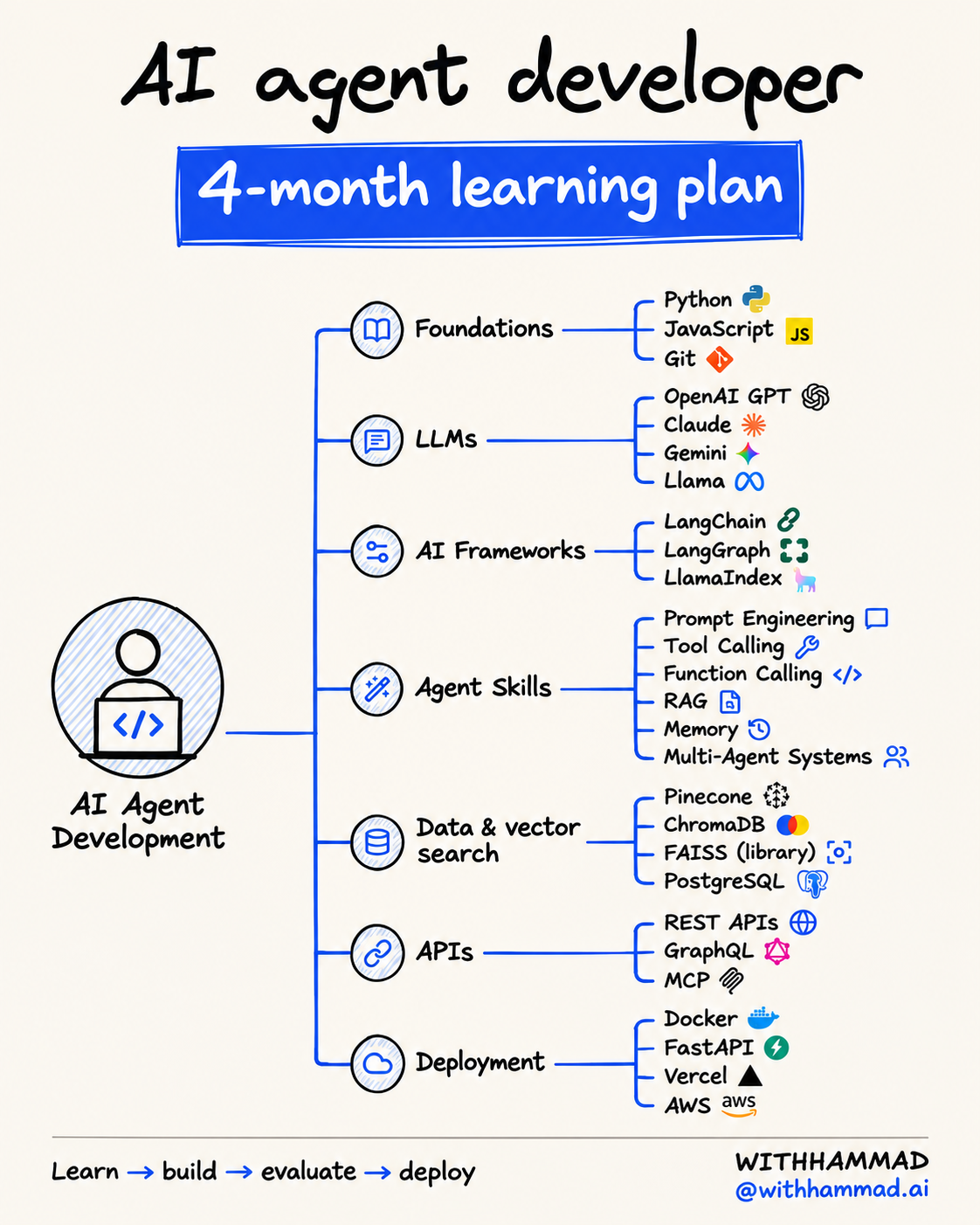
Month 1: foundations and one working API project
Choose Python or JavaScript as your main language. Learn functions, structured data, errors, HTTP requests and Git. Build a small command-line app that reads a file, calls an API and saves a result. Keep credentials outside the code and record what you learned in a README.
Milestone: another person can run your project from its instructions. Add a small set of tests for real failures, such as missing input or an API timeout.
Month 2: retrieval and one useful tool
Learn how prompts, model responses, retrieved context and tool calls fit together. Start with a simple workflow over a small, trusted document set. Compare its answers with a list of questions you have already answered yourself. Add source references and a clear response when the documents do not contain the answer.
Pick one storage route. The diagram includes vector databases, a search library and a relational database; they are not interchangeable products. FAISS is a vector similarity-search and clustering library, not a hosted database. FAISS documentation
Milestone: a document assistant retrieves the right passages for your test questions and performs one narrowly scoped action. Keep consequential actions behind a confirmation step.
Month 3: orchestration and evaluation
Use a framework only when it solves a problem your project actually has. The map includes LangChain, LangGraph and LlamaIndex as examples; you do not need all three. Start with one agent or a deterministic workflow. Add more agents only when separate roles improve measured results.
Evaluate answer quality, tool selection, latency and cost on a fixed set of examples. Include ambiguous requests, missing information, a failed tool, and malicious instructions inside retrieved text. Retrieved content is data, not authority to change your system's permissions.
MCP is a protocol for connecting AI applications to tools and data. It is not a replacement for access controls, evaluation or all other APIs. MCP introduction
Milestone: write down the failure cases and show that a change improves them without breaking previously correct results.
Month 4: deploy one small service
Choose one deployment route suitable for the project. Add authentication where needed, least-privilege tool access, input validation, timeouts, rate limits and spending limits. Log errors without exposing private prompts, tokens or user data. Document how to roll back and stop the service.
Milestone: publish a reproducible demo, a brief architecture diagram, a test set, measured limitations and a clear cost estimate. A reliable small project is more useful than a list of tools you have only installed.
Use the map as a checklist
Foundations → model use → retrieval and tools → evaluation → deployment. Revisit the seven branches as your project needs them. Do not try to learn every logo before building anything.
Visual reference: Victor de Chalendar's seven-branch infographic, adapted with WITHHAMMAD branding and factual clarifications. This guide's study sequence is an editorial plan, not a validated employment outcome.