"AI agent" is on the label of nearly every marketing tool now, next to "automation" and "AI-powered," as if the three words are interchangeable. They aren't, and the difference isn't branding — it's a real technical line that determines what the thing can actually do for you, and where it will quietly fail. This is the distinction as I actually build it, not as a vendor page defines it to sell a feature.
The real test: who decides the next step
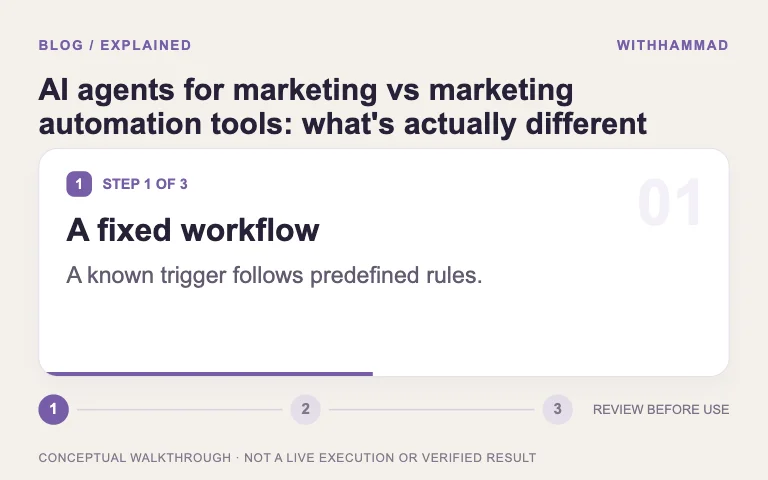
A marketing automation tool runs a workflow you designed in advance: trigger, wait, send, branch on a condition you wrote. Every path through it was drawn by a human before the first real user ever hit it. An AI agent is different in one specific way — it decides its own next step from a goal, not from a path you pre-drew. Give it "qualify this inbound lead" and it can choose to check the CRM, ask a clarifying question, or escalate to a human, based on what it actually finds — not because a diagram told it to branch there.
That gives a concrete test you can apply to anything with "AI agent" in its name: can it be wrong about which step to take next, not just wrong about the words in a template? A tool that always follows the same five steps regardless of what happens at step two is automation, however good the copy an LLM writes at step three. A system that can look at what came back from step two and decide step three doesn't apply this time is an agent.

Where most "AI marketing agent" products actually sit
Most tools carrying the label today are automation with an LLM writing inside one step of an otherwise fixed sequence — an email sequencer that has an LLM draft the subject line, a chatbot that has an LLM pick a canned reply from a wider set of canned replies. That's genuinely useful: LLM-written copy at a fixed step beats a static template, and it ships faster and cheaper than a true agent. The honest problem is only the label — calling it agentic implies it can handle a case you didn't anticipate, and a fixed-sequence tool by definition can't, however good the LLM inside one of its steps is.
The tell when you're evaluating one: ask what happens when the expected input doesn't show up — a lead with no email, a reply that doesn't match any of the branches, a tool call that returns an error. A fixed-sequence tool either breaks, silently drops the case, or falls back to a generic default. An actual agent has a decision to make there too, and a good one is honest that it can't fully resolve it and escalates instead of guessing.
What an agent needs to be one, not just claim to be one
Three things, in practice. Tool use: the ability to call something outside itself — a CRM lookup, a calendar check, a search — and read the result back into its own reasoning, not just fill a variable into a template. Branching from evidence: the next action has to change based on what the tool call actually returned, not follow a path chosen before the call ran. And an honest stop condition: knowing when it doesn't have enough to decide safely, and escalating to a human instead of guessing — the same principle that governs every agent on this site, badged clearly as real production data versus modeled projection rather than presented as more certain than it is.
Miss any one of the three and what you have is well-dressed automation. That's not an insult — automation is the right tool for a genuinely fixed process, and it's cheaper, faster to build, and easier to debug than an agent for exactly that reason. The mistake is buying automation while being sold an agent, because the price and the promise are usually pitched for the harder problem.
Why this distinction matters for a Dubai/GCC marketing team specifically
Two things make the gap between the label and the reality bite harder here than in a single-market, single-language business. First, bilingual handling: a fixed-sequence tool needs a separate pre-drawn branch for every Arabic/English variation of a case, and the branches multiply fast; an agent that actually reads intent handles the variation without a human having pre-drawn every path. Second, GCC-specific signals — a WhatsApp-first inbound flow, a UAE business hour pattern, a Ramadan seasonality shift — are exactly the kind of "case you didn't anticipate" that separates the two categories in practice, not in a spec sheet.
None of this is theoretical for me — it's the same distinction that decides how every agent on this site is actually built: tool use, evidence-based branching, and an honest escalation path, not a diagram with an LLM writing the copy inside one box. If you want to see the difference rather than read about it, the fastest way is to run one yourself and watch what it does when you give it a case that doesn't fit the obvious path.
Related reading
If this is useful, the five pillars I build every agent on — and the architecture behind 73 of them running live.